METER · Monitoring Technology

How Outdoor AdvertisingMonitoring Works

From verifying a structure to making data available in METER

A METER on-site monitoring specialist records an advertising structure next to a city scooter.On-site Monitoring · METER Monitoring

It may seem that analyzing out-of-home advertising only requires filming a screen, saving the video and counting which brands appeared. In practice, a long chain connects a street screen to a finished report: updating the structure database, assigning monitoring tasks to the on-site monitoring team, verifying geolocation, recording a complete advertising loop, automatically processing the video and reviewing every result.

This chain is necessary because of the nature of out-of-home advertising. The market has no single source that contains the history of every placement. Structures belong to different operators, are located in different cities, and the content on digital screens changes constantly. Once a campaign ends, a creative may disappear from rotation, making it difficult to reconstruct what actually ran after the fact.

That is why out-of-home advertising data must first be collected in the physical world before it can be turned into analytics.

A frame from a monitoring video showing questions about the brand, category, location and advertising surface.
To answer questions about advertising activity, the placements themselves must first be recorded.

METER began systematic monitoring in 2022. Today, the system contains 7,285 structures across five countries: 2,479 in Uzbekistan, 2,088 in Türkiye, 1,498 in the UAE, 1,161 in Kazakhstan and 59 in Tajikistan.

Over the past seven months, the team recorded an average of about 149 hours of video per month. The largest volumes came from Uzbekistan, with 63.78 hours per month, and Kazakhstan, with 51.17 hours. Every one of those hours must be converted into individual, verified records linked to specific advertising surfaces.

7,285structures
5countries
≈149 hoursvideo per month
since 2022monitoring in operation

Infrastructure

Number of structures

7,285
Uzbekistan 2,479
Türkiye 2,088
UAE 1,498
Kazakhstan 1,161
Tajikistan 59

Field volume

Monthly capture, hours

≈149
Uzbekistan 63.78 hr
Türkiye 22.15 hr
UAE 3.90 hr
Kazakhstan 51.17 hr
Tajikistan 8.01 hr
A visualization of an advertising-surface network and its linked monitoring data.
Monitoring brings together data from thousands of advertising structures across cities and countries.

But the process begins long before an on-site monitoring specialist arrives at a screen.

Video · METER MonitoringSee how METER monitoring worksFollow the data from on-site capture through processing and into METER products.

01 / 12

First, the screen must enter the system

First, the screen must enter the system

The advertising structure database changes continuously along with the urban environment. Operators install new screens, remove old surfaces, and change formats and technical specifications. The inventory must therefore be updated continuously.

Information about a new structure may come from METER analysts, moderators or employees conducting monitoring in the city. Advertising agencies, advertisers and other market participants can also submit requests.

Every request is verified. The team confirms the address and the surface's physical presence, checks its status, operator and structure type, and searches the inventory for duplicates.

Once verified, the screen is added to the system and becomes available for monitoring assignments.

The process follows a clear sequence:

  1. 01surface discovery
  2. 02request
  3. 03moderation
  4. 04verification
  5. 05database entry
  6. 06on-site capture assignment

surface discovery → request → moderation → verification → database entry → on-site capture assignment.

This creates a verified inventory of advertising infrastructure that supports all subsequent monitoring activities.

02 / 12

The digital structure profile

The digital structure profile

A separate profile is created for every verified surface. It stores coordinates, latitude and longitude, operator, structure type, capture point, azimuth and other technical parameters.

This information makes it possible to link each future recording to the correct physical asset.

Several screens in a city may stand close together, belong to the same operator or occupy different sides of one structure. Coordinates and the capture direction help the employee find the right surface and record the exact side specified in the assignment.

The capture point also affects the quality of the material. One screen may be most visible from across the road, another from the direction of traffic, and a third only from a particular angle. All these parameters are entered in the profile in advance.

If the surface changes, its profile is updated, keeping the database aligned with the real urban infrastructure.

Illustrative example

Structure profileTAS · DOOH · 0412
Ready for capture

Surface data

CityTashkent
FormatDigital · 3 × 6 m
Coordinatesrecorded
Operatorlinked to profile
Capture pointGPS verified
Azimuth118°
The screen, its coordinates and the verified capture point are combined into a single monitoring assignment.

03 / 12

How on-site monitoring works

How on-site monitoring works

Monitoring is carried out through METER's own mobile app.

A team coordinator creates assignments and distributes structures among employees. Each employee receives a personal list of surfaces to check and capture in the app.

Employees choose the order in which they visit the assigned points, allowing them to account for distance, traffic, time of day and the specifics of each city.

The app displays the assigned surface profile and instructions. The employee can see the asset location, the required side of the structure, the capture point and other parameters.

Before work begins, the app checks the device's geolocation. Recording takes place next to the specified surface, and the material is immediately linked to the corresponding assignment.

This records the location, time and source at the field stage itself.

A METER employee records a digital advertising screen on a smartphone.
A on-site monitoring specialist records the material next to the assigned structure.
Location confirmedTask IDDate · timeCapture point
A METER on-site monitoring specialist records an advertising structure next to a city scooter.On-site monitoringHow a METER monitoring visit worksThe specialist travels between assigned structures, verifies the correct screen and records the advertising material in the app.Watch the video ↗

04 / 12

Static and digital: two different capture scenarios

Static and digital: two different capture scenarios

For a static surface, the employee takes a photograph showing both the advertisement and the structure itself.

Digital screens require more time. A single screen may show dozens of creatives from different advertisers, while the total length of the advertising block depends on the operator's settings and current inventory.

For that reason, the recording duration is not set in advance. The employee captures the complete advertising loop and waits for the first two creatives to repeat in the next loop.

A loop may take only a few minutes on one surface and considerably longer on another. Its duration depends on the actual number of creatives in rotation.

Capturing the full loop reveals the complete advertising block, makes it possible to isolate individual creatives and correctly link every recorded brand to a specific screen.

The quality of the final data depends heavily on the completeness of the original recording. Anything missed during capture cannot be recovered later in the processing workflow.

Static

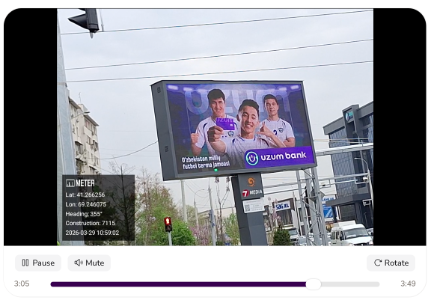
A on-site capture frame showing an Uzum Bank advertising screen and METER metadata

A single frame links the advertisement to the structure itself.

Digital · full loop

Creative A
Creative B
Creative C
Creative D
Creative ANext loop begins
Creative BRepeat confirmed

Recording ends once creatives A and B repeat in the next loop.

The METER app interface shown to an on-site monitoring specialist while capturing an advertising structure.App interfaceWhat the specialist sees in the app during captureThe video shows how an assignment appears to the specialist: the assigned structure, capture point, geolocation and recording parameters.Watch the video ↗

05 / 12

What happens when a screen is offline

What happens when a screen is offline

Field monitoring also records exceptional situations.

A screen may be temporarily switched off, experience a technical fault, show no advertising or be inaccessible for capture. Sometimes a structure has been dismantled or obstructed by construction elements.

The employee records the reason why the assignment could not be completed in the app.

These comments help track the monitoring process while clarifying the current state of the structure database. Repeated reports trigger an additional surface check and a status update.

In this way, on-site monitoring specialists collect advertising data while keeping the inventory up to date.

01screen temporarily offline
02technical fault
03structure inaccessible or dismantled
employee comment→additional verification→surface status update

06 / 12

Uploading the video

Uploading the video

After recording is complete, the employee submits the material through the app. The video is uploaded directly to the METER server and linked to the assigned task and surface profile.

The server receives the original recording of the complete advertising loop. It contains creatives from different brands, transitions between them, operator bumpers and repeated elements.

Processing then begins: the loop must be split into separate fragments, the duration of each creative calculated, the brand and category identified, the result checked, and the record added to the database.

Until early 2026, much of this work was done manually. Specialists reviewed the full loop, identified the boundaries between creatives and completed each record.

As geographic coverage expanded, so did the volume of video. With an average of about 149 hours per month, manual processing required increasingly more time. Automation became the next stage of development.

A frame from a METER video about capturing an advertising screen and processing the material.
A frame from METER's official monitoring technology video.
Phone→METER server→Processing

07 / 12

Moving to AI-assisted processing

Moving to AI-assisted processing

In early 2026, METER integrated artificial intelligence into its video-processing workflow.

Once a complete loop is uploaded, the system performs the initial analysis: it identifies creative boundaries, splits the recording into separate fragments, calculates duration, recognizes the brand, suggests a category and prepares the result for review.

The moderator receives the processed materials as individual items. This has significantly reduced the time between on-site capture and the appearance of a record in the system, while allowing the team to handle a growing volume of video without an equivalent increase in manual workload.

The AI model continues to learn. New materials and moderator corrections are used to improve the accuracy of subsequent processing. As more verified data passes through the system, the model becomes better at handling local brands, creative formats and the specifics of different markets.

2022systematic monitoring launched
2022–2025process development and manual processing
early 2026AI integrated
todaycontinuous model learning

Before AI integration

reviewing the complete loopmanually isolating creativesmanually completing records

After AI integration

initial automated analysisidentifying creative boundariescalculating durationrecognizing the brandsuggesting a categorysending the result to a moderator

08 / 12

Every item undergoes full moderation

Every item undergoes full moderation

After automated processing, the creatives are sent to local moderators.

The specialist checks the video boundaries, the start and end of the creative, its duration, brand, advertiser, category, language, text content and link to the specific surface. The operator, city, date, time and all other record parameters are also confirmed.

This review is especially important when a brand appears only in the final frame, a specific product is being promoted, or several companies appear at once.

Local specifics add another layer of complexity: slogans in Uzbek, Kazakh, Turkish or Arabic, different transliterations, abbreviations and product names.

That is why each market is covered by specialists who understand the local language and advertising context.

Local expertise complements the speed of automated processing and helps maintain consistent data-quality standards across all monitored countries.

Local moderator review

✓ video boundaries✓ start and end✓ duration✓ brand✓ advertiser✓ category✓ language✓ text content✓ surface link✓ operator✓ city✓ date and time✓ other parameters
AI processes→moderator reviews→corrections support model learning

09 / 12

What the result looks like

What the result looks like

After verification, the original video becomes a set of structured records describing advertising activity.

For every recorded placement, the system stores the advertising creative, brand, advertiser, category, duration, surface, operator, country, city, capture date and time, along with verified geographic and technical parameters.

The material can therefore be analyzed by brand, category, city, operator, surface type and time period.

For example, users can see where a particular brand was recorded, which structures it appeared on and how its activity changed over the available period.

The advertising creative itself remains in the database, so the data can be compared with the actual material shown on the screen at the time of capture.

The link between the video, time and physical surface makes every record verifiable and suitable for further analysis.

Advertising surfaces linked to brand, category and location parameters.
After processing, each advertising creative is linked to a specific surface and verified parameters.

Example result

From a frame to a verified record
Moderation complete
Original on-site capture frame showing an Uzum Bank advertising screen
Source frame
Advertising creativevideo saved
BrandUzum Bank
Advertiserverified
Categoryassigned by moderator
Durationcalculated from creative
Surfacelinked to structure ID
Operatorlinked to surface
GeographyGPS verified
Date and timesaved

The video, time and physical surface remain linked, allowing the record to be checked against the source material.

10 / 12

Data becomes available as it is processed

Data becomes available as it is processed

After moderation, the record is added to the METER database immediately.

Materials are processed sequentially, so new results appear in the system as soon as they are ready. This approach reduces the time between on-site capture and data availability for analysis.

Speed matters in competitive monitoring: campaigns launch and end, brands change creatives, and activity shifts between cities and operators.

Regular on-site capture and prompt processing make it possible to record these changes closer to the moment they appear in the market.

  1. 1Uploaded
  2. 2AI processed
  3. 3Moderated
  4. 4Available

11 / 12

The next level of working with data

The next level of working with data

METER's analytics and technology products are built on monitoring data: METER.Report, METER.Agent, METER.RePlay, METER.AdCreative and METER.AlertBot.

Each product uses the collected material differently. METER.Report helps analyze market activity, METER.RePlay provides access to recorded creatives, METER.Agent generates answers based on the database, METER.AdCreative works with advertising content, and METER.AlertBot reports updates.

These products will be covered in detail in separate articles. They all share one source: verified monitoring data.

A visualization of analytics based on METER monitoring data.
From captured monitoring data to market analytics.
A frame showing how monitoring data is used across METER products.
An official visualization of the ecosystem for working with monitoring data.

12 / 12

How Outdoor Advertising Monitoring Works

How Outdoor Advertising Monitoring Works

In the final report, the result looks compact: brand, city, surface, period and advertising creative. Behind that record is the work of analysts, a monitoring coordinator, the on-site monitoring team, the AI system and local moderators.

METER began systematic out-of-home advertising monitoring in 2022. Since early 2026, AI-assisted processing has helped analyze video faster and add results to the database.

Today, the system covers 7,285 structures across five countries and processes an average of about 149 hours of video every month.

Every creative in the database is linked to a real surface, capture location and time, and undergoes full verification. This is how advertising recorded on a city screen becomes structured data about the out-of-home advertising market.

7,285 structures5 countries≈149 hours of video per month
A visualization of an advertising-surface network and its linked monitoring data.Video · METER MonitoringThe complete monitoring process in one videoHow on-site capture, AI processing and moderation turn content from city screens into structured METER data.